Current Research
The Standard Model (SM) is our best theory for describing the elementary particles and forces that make up our universe. However, it cannot explain some of the biggest mysteries, such as what dark matter is or why the universe contains more matter than antimatter. Moreover, despite the unprecedented energies reached by the Large Hadron Collider (LHC), no new particles beyond the SM (BSM) have yet been discovered. In this landscape, precision measurements play a powerful role: by studying known processes in great detail, even very small deviations from predictions can point to new physics. Therefore, my current work focuses on precision studies of electroweak interactions, with a particular emphasis on improving parton distribution functions (PDFs) that describe the proton’s internal structure and currently limit the precision of many experimental results.
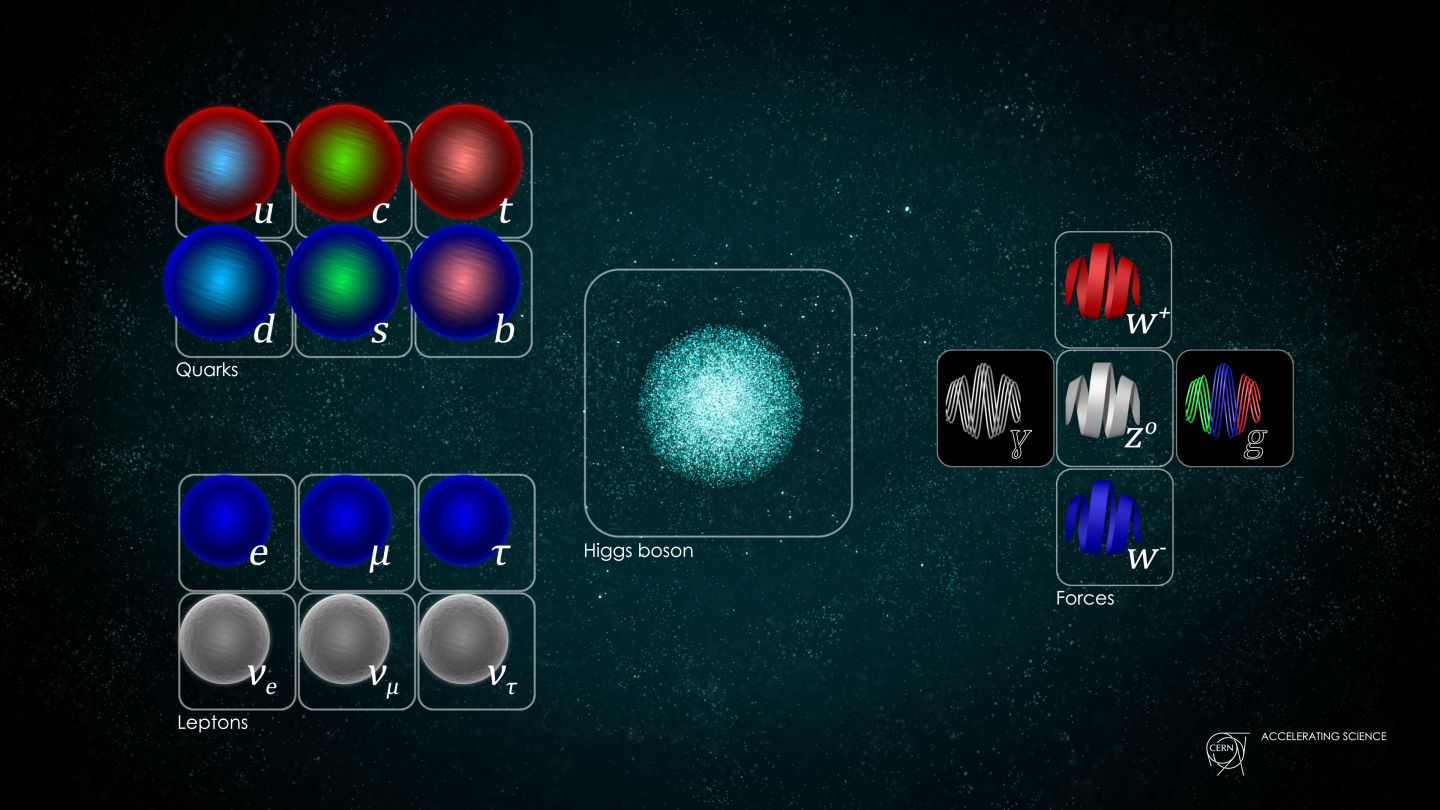
The Standard Model of Particle Physics
1) Precision Measurement of the Weak Mixing Angle (ATLAS)
Show more
The weak mixing angle is a fundamental parameter that governs the interplay between the electromagnetic and weak forces. Its precise determination provides one of the most stringent tests of the SM, and is crucial for addressing a long-standing 3.2$\sigma$ tension between results from previous lepton collider experiments. Using ATLAS data, I lead a novel analysis strategy that simultaneously constrains both the weak mixing angle and PDFs, which is the dominant theoretical uncertainty in this measurement. Achieving high precision also requires careful treatment of higher-order electroweak theory input, to which I actively contribute. Notably, the expected precision of this measurement is comparable to that reached at earlier lepton colliders, demonstrating how the LHC- originally designed as a discovery machine- has also become a powerful tool for precision electroweak studies. In parallel, I lead the ATLAS inputs to a global measurement of the weak mixing angle using data from the LHC and Tevatron experiments.
2) Level-1 Trigger Development for Forward Electrons (ATLAS)
Show more
The LHC produces collisions at an extremely high rate, far exceeding data storage and processing capabilities. Therefore, the hardware-based ATLAS Level-1 Calorimeter Trigger (L1Calo) rapidly selects collision events of interest by identifying energetic particles from calorimeter information. Among these, forward electrons- produced at small angles relative to the beamline- are important for precision measurements (such as the weak mixing angle), but difficult to identify due to high background rates and limited detector coverage. My work focuses on improving their identification through the development of a dedicated monitoring framework within L1Calo.
3) EFT+PDF Fit with High-Mass $W$ Data (Phenomenology)
Show more
Any deviation from SM predictions could signal new physics and can be interpreted using the model-independent effective field theory (EFT) framework, which parameterises such effects through higher-dimension terms. A recent ATLAS publication on high-mass $W$ boson production has shown that reducing PDF uncertainties from 90% to 68% confidence level improves constraints on EFT terms by factors of 1.1 to 1.4. This highlights that treating EFT effects and PDF fits separately can bias theoretical predictions and interpretations. Thus, I have collaborated with theorists to lead a novel simultaneous EFT+PDF analysis using ATLAS high-mass $W$ data. This combined approach provides a reliable interpretation of high-energy data and will be essential in guiding future discoveries.
Selected Previous Research
Some key projects that form the foundation of my current research programme:
1) Precision Measurement and Interpretation of $Z\gamma$ Scattering (ATLAS)
Show more
Vector boson scattering (VBS) is a rare electroweak process that probes quartic gauge couplings (QGCs) i.e. when four force-carrying particles interact simultaneously. As a principal analyst, I contributed to all key aspects of the $Z\gamma$ scattering analysis, including strategy development, Monte Carlo simulation production, and unfolding studies. This work led to the first observation of this process with ATLAS, and notably, the first differential cross-section measurement of a VBS process within the collaboration. I also contributed to a combined EFT interpretation of ATLAS QGC measurements, in which this $Z\gamma$ result was a key input. The joint analysis improved constraints on EFT operators by up to 96% in the EFT-valid energy regime, significantly enhancing sensitivity to new physics.
2) Upgrade of Liquid Argon Electronic Calibration Board (ATLAS)
Show more
The ATLAS Liquid Argon Calorimeter records the energies of particles produced in LHC collisions. To deliver precise and accurate energy measurements, it relies on dedicated calibration boards that probe the calorimeter's electronic response. For the High-Luminosity LHC (HL-LHC), these boards must be upgraded to withstand high radiation levels while maintaining uniform performance across all calibration channels. To address these goals, I carried out irradiation tests of a custom-designed calibration chip used in the board and developed comprehensive tests to identify sources of non-uniformity in the first calibration board prototype. This work will inform the design and validation of the final calibration boards for the HL-LHC.
3) Interpretation of Higgs Pair Production (CMS)
Show more
Since the discovery of the Higgs boson, a major goal in particle physics has been to understand its properties and interactions, including its interaction with itself, known as the Higgs self-coupling. This self-coupling can be measured directly only through the production of Higgs boson pairs, a very rare process at the LHC. To support this effort, I developed a boosted decision tree (BDT) to model the CMS detector response to Higgs pair production under SM and BSM scenarios. This BDT acts as a powerful tool to reinterpret experimental data across different theoretical frameworks at the detector level.